• Facebook
    • Google+
    • Twitter
    • Get new posts sent to your inbox!
      Enter your email address below:

  • Thursday, February 28, 2013

    Q&A: Shelters Vs. Tents on the Appalachian Trail

    (Photo: Jeffers Brook Shelter, New Hampshire)
    This is my fourth and final question from 2013 Appalachian Trail thru-hiker Victor Maisano. He and his friends will be heading to Springer Mountain in March. Follow their progress at BackpackingAT.com

    Shelters Vs. Tents

    Victor: We are planning to do this hike in a little over 5 months as all people in our hiking party have obligations right after. With that said, do you think there is an advantage for people who tent the whole trail (vs. sleeping in shelters) as they are able to get a couple more miles of hiking in as there are more places to camp and you’re not as confined to a certain distance?

    (Photo: Overmountain Shelter,
    Tennessee) 
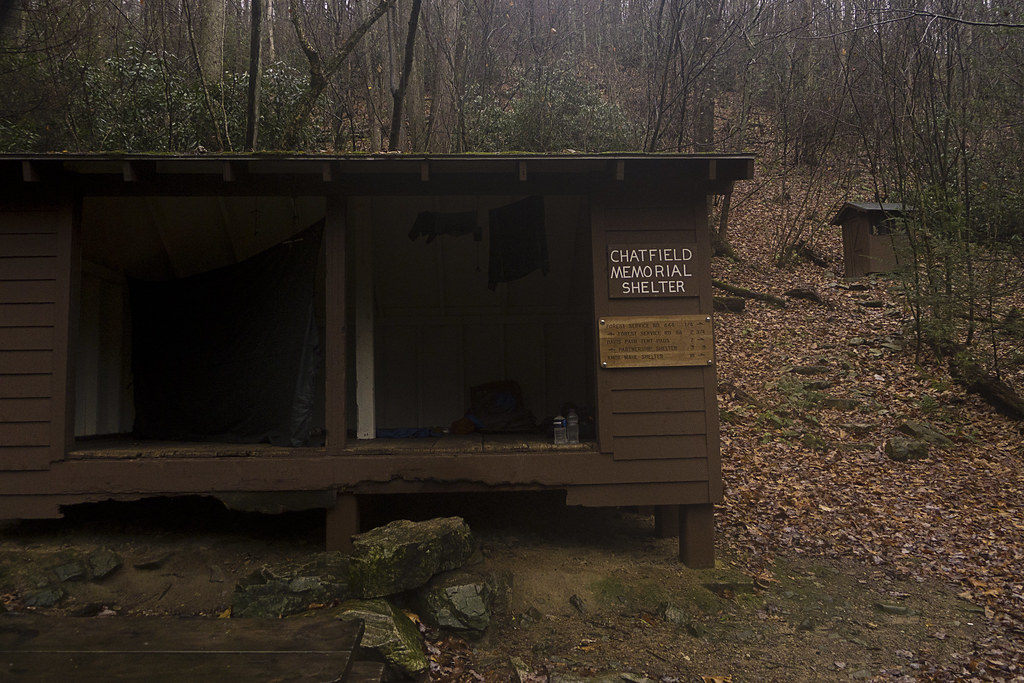
    Me: First, here is an overview for people unfamiliar with the Appalachian Trail shelters. There are over 260 shelters along the AT (all built by volunteers). Most are three-walled lean-tos similar to the photo above. You will also see some with four walls, a couple are cabins, a few have fireplaces, some have bunk beds (i.e. hiker shelves), one is an old barn, and many you'll want to stay in simply for their uniqueness.

    (Photo: Chatfield Memorial
    Shelter, Virginia)
    Most of the shelters have a fire ring, pit toilet, and some kind of water source nearby: a creek, spring, pond, etc. The average distance between shelters is only 8.5 miles, so other than a couple long stretches, they are close enough that you could easily hike the entire Appalachian Trail without a tent.

    A few of the shelters in New Hampshire and Vermont have fees, but nearly all of them are free of charge. New Hampshire has some other differences that I’ll talk more about below.

    (Photo: The 501 Shelter,
    Pennsylvania)
    Will shelters reduce the number of miles you hike?

    Overall, I'd say no. More often than not, they pushed me to go further. If I knew a shelter was only a few more miles ahead, I'd keep going even if I was ready to stop.

    I also didn't mind hiking to a shelter well after dark, because I didn't have to worry about finding a campsite and a water source before sundown. You'll also spend less time taking down camp in the morning if you stay in a shelter.

    (Photo: Spruce Peak Cabin,
    Vermont. My favorite Shelter!)
    Another reason to stay in shelters is to get to know other thru-hikers. Even though I guarantee you’ll have some snorers, and a few mice, you'll meet a lot of great people in AT shelters. If you’re as lucky as me, you’ll find some of your best friends in there. (I'm talking about you, Drifters. You know who you are.)

    There is nothing like the shelter system on the AT, and in my opinion, they are an essential part of the full AT experience.
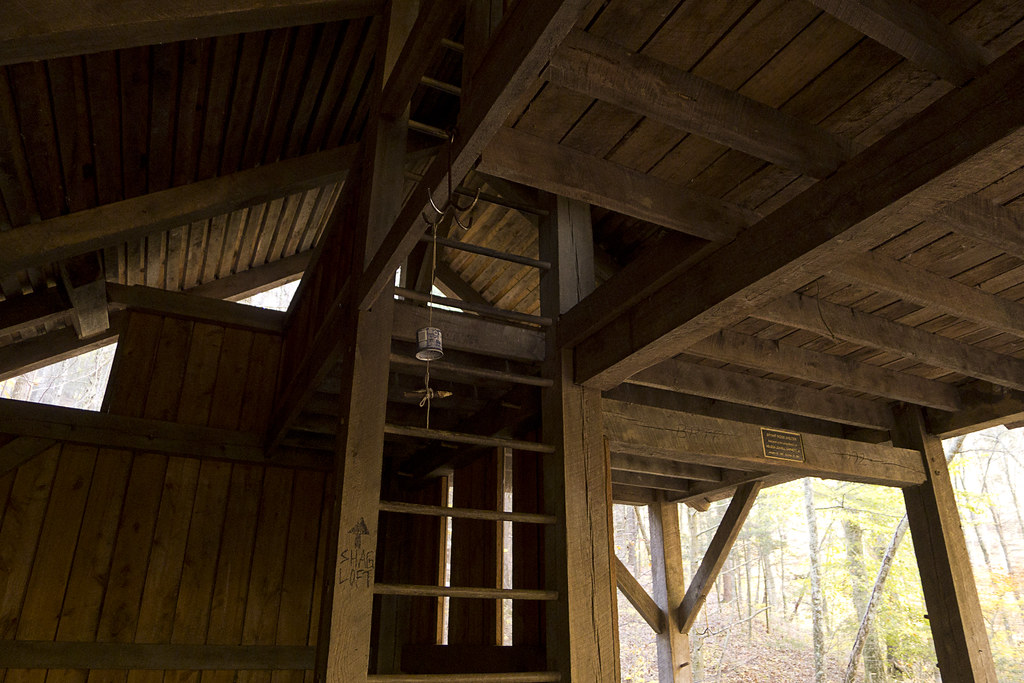
    (Photo: Shelter with a loft in Virginia)
    Having said all that, you may want to tent more often in the first couple of weeks. The trail might be crowded for you in the beginning, since a majority of thru-hikers start at Springer Mountain in March. During this time, some hikers will end days early to guarantee a spot in a shelter, and many will end their days earlier at first until they are in better shape and have reduced their pack weight.

    It won’t be crowded for long, though. Hikers will eventually put more distance between one another and as many as one-fourth will drop out in the first two weeks.
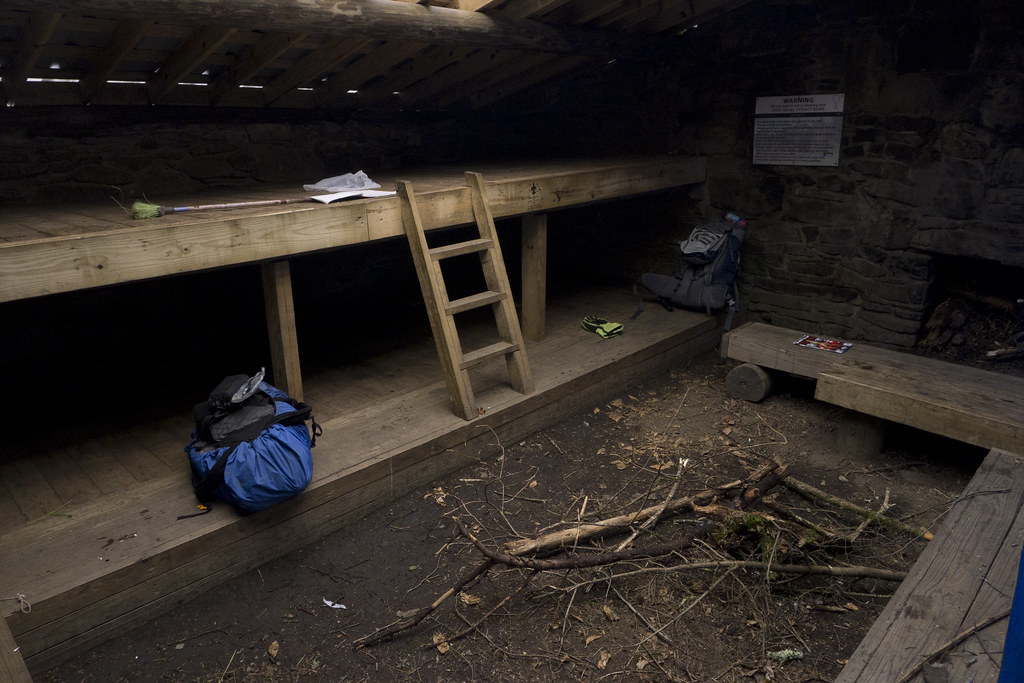
    (Photo: Smoky Mountain Shelter,
    in Tennessee, with a fireplace)
    Another reason to occasionally skip the shelters is that some of your best memories will come from things like cowboy camping under the stars on a treeless mountaintop, spending a night alone deep in the woods, or finding a stealthy place to sleep in a town.

    (Photo: Slept behind an
    abandoned bank in NH)
    New Hampshire

    New Hampshire has some differences that I wanted to point out. First, don’t plan on hiking through the whole state of New Hampshire without a tent, unless you want to pay. There are numerous campsites, shelters, and huts in New Hampshire that have a fee, primarily around the White Mountains. Although, you don't have to stay at these pay sites. There are plenty of free places to camp, as long as you are below tree line.

    (Photo: NH's Zealand Hut)
    The hut system in New Hampshire is unique to the AT as well. They are small cabins or lodges in the White Mountains. They can cost over $100 per night, which includes dinner and breakfast, but if you get to one early enough you might be able to do “work-for-stay.”

    The caretakers will usually let two to four thru-hikers in the huts for free, as long as you stick around to wash dishes, make beds, sweep the floors, or give a talk to their guests about your experiences on the AT.
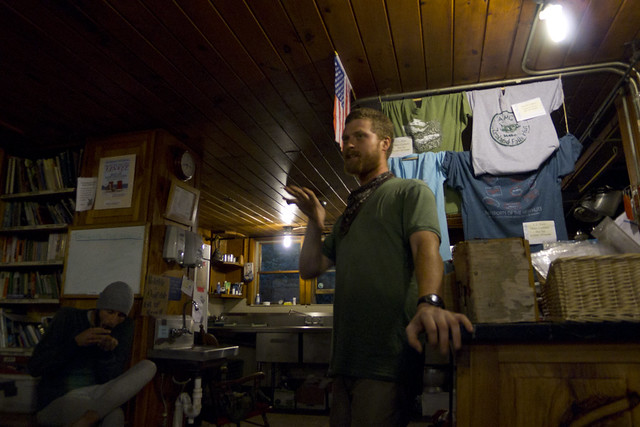
    (Photo: Red giving a speech for
    his work-for-stay)
    The best part is they’ll also feed you for free. Since the huts are in the middle of protected forests, the caretakers have to carry out all the leftovers. They really don’t want to do that, so they'd prefer to let you eat them. Even if you don’t do work-for-stay, they may give you some leftovers if you stop in and ask. Actually, I met one hiker whose only work-for-stay job was to eat all the ham they had left!

    Tips for getting work-for-stay

    You can increase your chances of getting work-for-stay if you arrive early, but not too early.  If they think you have enough time to get to the next hut, they'll tell you to keep going. If you get there too late, other thru-hikers will beat you to it. So, lets say, you stop at a hut that is six miles from the next hut. They will probably start accepting work-for-stay two to three hours before sundown.

    If there are still four of you in the group when you get to New Hampshire, you will have better luck if you split up into two groups of two. If you don't get work-for-stay, ask them if you can setup camp nearby and at least work for a meal.

    The best hut for northbounders to stay at is the Lake of the Clouds hut. It's located at the base of Mount Washington, and the remaining section of trail in the Presidential Range. Since you can't camp above tree line in this area, it's a great place to end your day, so you can easily get through this section by nightfall the following day. The good news is, this hut allows ten hikers to stay in their basement (lovingly called The Dungeon). Additionally, because of its location, northbounders will get dibs.
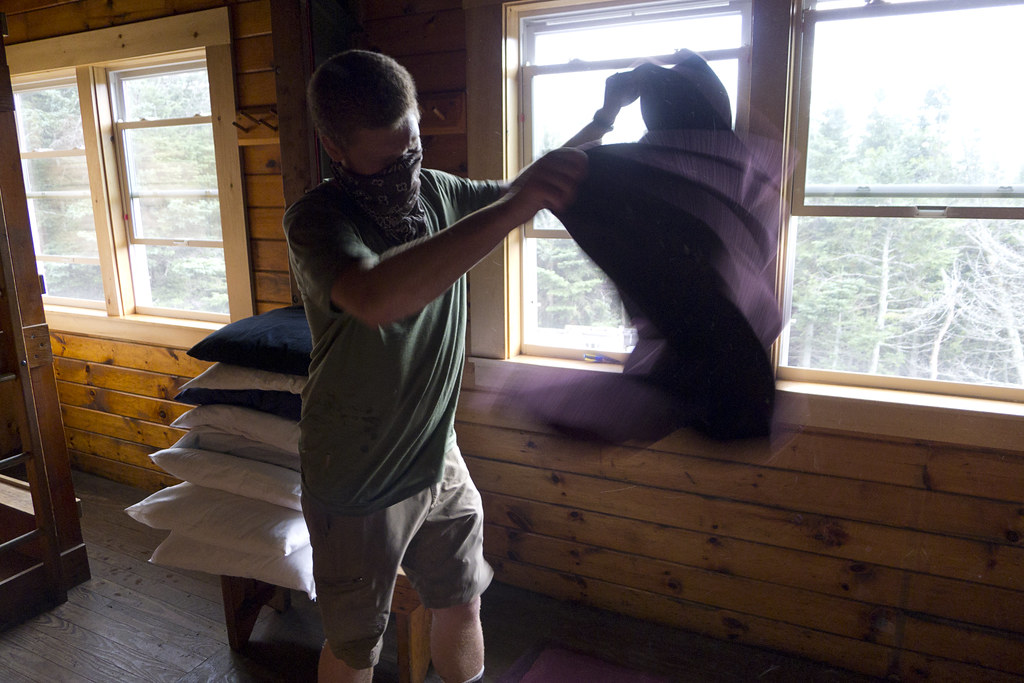
    (Photo: Red doing work-for-stay)
    My final tip, if you do get work-for-stay, go out of your way to do a great job and you might be able to guarantee a spot in one of the other huts. The caretakers at the Mizpah Hut gave Red and I the task of shaking the dust out of all their blankets, sweeping the floors afterwards, and then folding the blankets. Two hours later, they told us we worked long enough and could leave, but we insisted on staying until the job was done. Before we left, they asked if we could deliver a sealed note to the next hut.

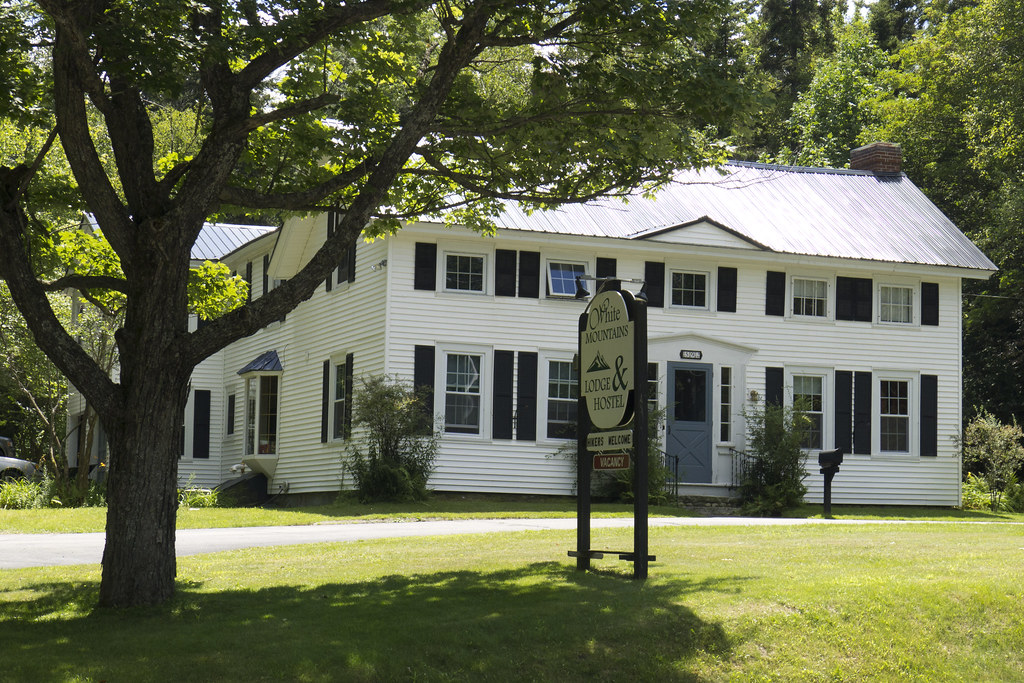
    (Photo: White Mountain Hostel in
    NH. My favorite hostel anywhere.)
    When we arrived, there were already four thru-hikers out front who said the hut was full. Red and I walked in to deliver the note to a caretaker. He read it then looked up and said, “So, do you guys want to stay here tonight?”

    Red happened to get a look at the note. It said, “These guys do kick ass work!”

    (Photo: Slept in a dugout in Maine)
    In Conclusion

    So, my recommendation is to mix it up. Experience it all. Stay in shelters, setup camps next to sunset views, cowboy camp around a fire, sleep on mountain tops without a tent and fall asleep while staring at the stars. When in town, find random places to sleep, stay in hostels. or split the cost of a hotel room with other hikers. It's also likely that you'll meet strangers along the way and get invited to stay in their homes.
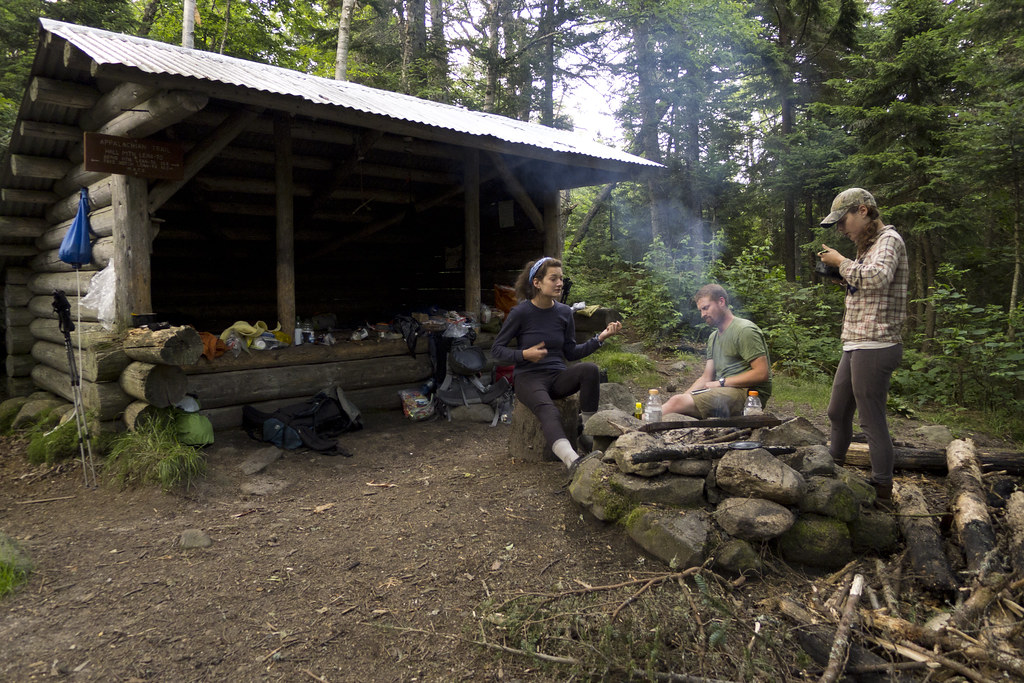
    (Photo: Some of my favorite
    people I met in a shelter)
    As long as you occasionally calculate the average daily miles you need to finish by your deadline, you’ll naturally do what you have to do to finish. Nothing will compare to the emotion you will feel when you get to Katahdin, but that isn’t the only thing you’ll remember. It will be the people you met and the places you spent the night that you’ll talk about for years.
    - - -

    Since this is the last question, here are a few last bits of advice.

    If you feel terrible, or the weather is making you miserable, take a day or two off. And don't feel guilty about it. A day off is better than being so miserable that you think about going home. I found that once that thought got into a thru-hiker's mind, it was only a matter of time before they headed home.

    Avoid Branchville, New Jersey. It seems like a convenient place to resupply, but just walk on by. Especially the Joe-to-Go coffee and sandwich shop. He has a well-known reputation for despising hikers and treating them like garbage. There are forums at whiteblaze.net devoted to altercations with that guy.

    Take pictures of people. Landscape shots are great, but after your hike, you'll be glad you took photos of the people you met. They, more than the views and the miles, will define your experience on the AT.

    Finally, don't skip any miles. They say about 1 in 5 will finish the trail, but it's actually much less than that. Most hikers I met skipped large sections of trail. The feeling at the end will be much greater if you know you passed every white blaze.

    I had to skip a section after damage from Hurricane Irene closed down the Green Mountains National Forest. I regretted it the whole trip. I wished I would have risked the $5000 fine that they threatened to impose if we were caught in the park. I eventually went back the following April and finished that section when I hiked the Long Trail in Vermont. That turned my disappointment into another great trip, so I don't regret it anymore. However, if you're ever tempted to skip even one mile, ask yourself how you'd feel if you stopped one mile from Katahdin.

    Victor, thanks for giving me the opportunity to answer your questions and good luck on your journey! It will be one of the most memorable five months of your life. I look forward to reliving the experience through your stories.

    Once again, you can follow Victor and his friends on their AT journey at BackpackingAT.com.


    More Q&As with Victor:

    Bugs and other Pests on the Appalachian Trail
    Weather and Morale on the Appalachian Trail
    Knives on the Appalachian Trail
    Hiking with Visitors on the Appalachian Trail
    Online Mail Drops on the Appalachian Trail


    Creative Commons License
    A Backpacker's Life List by Ryan Grayson is licensed under a Creative Commons Attribution-NonCommercial-NoDerivs 3.0 Unported License.   

    Monday, February 25, 2013

    Q&A: Knives on the Appalachian Trail

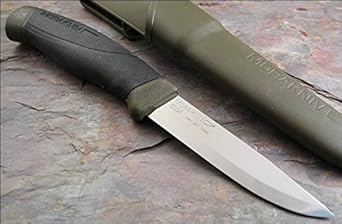
    (Photo: The knife I now carry,  the popular
    Swedish Military Mora Knife)
    Here is the third question from Victor Maisano, 2013 Appalachian Trail thru-hiker. 

    Follow Victor's progress at BackpackingAT.com

    Knives on the AT

    Victor: How many knives do you need to bring on the AT? As an Eagle Scout and He-Man fan, I love playing with knives. I am thinking about bringing a multi-tool (Skeletol), a small serrated pocketknife, and perhaps a large blade (Buck knife) to be strapped to my backpack for defense and possibly splitting wood. Do you think that is overkill? 

    Me: Generally, anything redundant on a long-distance hike will end up being sent back home or chucked in a hiker box. I cut my toothbrush in half to reduce my pack weight, which I admit is ridiculous. With 300 miles to go, I even sent my tent home to save weight. So, I would choose one knife and maybe consider letting the other people in your group carry the others.

    When it comes to gear advice, it's hard to tell another backpacker what they should carry, because gear choices are relative to each hiker's preference. I mean, my He-Man fandom makes me want to ride a green armored tiger down the trail, so clearly we are all unique. If you like to play with knives, whittle, or want to split wood, your needs will be different than mine. Although, to be fair, everyone wants to charge through the woods on the back of a green tiger.

    Nevertheless, when choosing gear, it is helpful to learn why hikers do what they do, so I'll stick to that. 

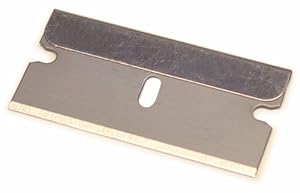
    I've carried a few different types of blades on the trails: a multi-tool, lightweight pocket knives, serrated and non-serrated, and a fixed-blade knife, but lately, and more often than not, I just carry a razor blade in my matchbox.

    I suspect a lot of people will disagree with me on that, so for the record, I'm not saying there is zero risk in not carrying a proper knife.

    I agree that no tool is more useful in a survival situation than a knife. You can use it to build shelter, light a fire, and procure food and water, but on a trail like the AT, it's not likely you'll need it for that. You'll probably see at least one hiker every day, and you'll never be more than a few days from a road or town, as long as you stick to the trail.

    So far, regardless of what I've carried, a razor blade is all I've ever really needed. Usually, when I pull out my knife it's to slice a block of cheese or cut cordage or rope. It doesn't mean a knife hasn't been useful for other things, or offered some peace of mind, it's just that I could have always gotten by with a simple razor blade.

    That being said, if I'm going into a remote area or if there is a chance I'll be going off-trail, I'll take my 4 oz. Swedish Mora (fixed-blade) knife. This seems to be a very popular knife lately, so I jumped on the bandwagon. It's cheap, lightweight, and has a durable sharp blade that can easily be sharpened in the field.

    Defense and Safety

    There aren't many wildlife encounters where a knife will be more helpful than learning how to properly handle the situation. For example, click here for the National Park Service guidelines for bear safety. You may have been thinking more about encounters with other humans, though. That is also very rare on the AT, but it happens. It would be a miracle if it never happened, but it is less frequent than if walking down a street. 

    So in conclusion, since it's very likely you will be trying to lighten your pack during the first few days or weeks on the trail, to save you the hassle of shipping your other knives back home, my recommendation is to only carry one. Choose the one that you feel offers the best combination of usefulness and lightness. That will probably be the serrated pocketknife, but if you feel better about having the heavier buck knife, by all means, take it. A few ounces are worth the peace of mind. As with all gear, as long as you're thinking about why you are carrying it, and accept the risks of not carrying it, you'll make the right choice for you.

    Now if you'll excuse me, I'm going to go search for He-Man cartoons on You Tube.


    More Q&As with Victor:

    Bugs and other Pests on the Appalachian Trail
    Weather and Morale on the Appalachian Trail
    Shelters Vs. Tents on the Appalachian Trail
    Hiking with Visitors on the Appalachian Trail
    Online Mail Drops on the Appalachian Trail
      
    Creative Commons License
    A Backpacker's Life List by Ryan Grayson is licensed under a Creative Commons Attribution-NonCommercial-NoDerivs 3.0 Unported License.   
    Saturday, February 23, 2013

    Q&A: Hiking With Visitors

    (Photo: My sisters on the Appalachian Trail)
    Sorry it has taken me so long to post my next Q&A with Victor. I need to hurry because, him and his friends will begin their thru-hike of the Appalachian Trail very soon. Please join me in following their progress at BackpackingAT.com.

    I've been working to save money for my next big hike, but right now I'm sitting in a fast food joint eating lunch, so I'm ready to answer another question. I'm really enjoying these posts. I hope Victor is getting as much out of them as I am.

    Hiking with Visitors on the Appalachian Trail

    Victor: It's got to be soooo relieving when you're in the middle of a thru-hike and see family or friends along the way. Now, what if these people joined you for a weekend? Would you imagine this would slow you down immensely or actually be detrimental to the hike overall?

    Me: It probably will slow you down, but that's alright. Especially if you have them visit you early in your trip, so you have plenty of time to make up lost miles.

    (Photo: One of my sisters trying to get a break by
    jumping on my other sister's back. It didn't work out.)
    Once you've been on the trail for a few weeks, you might be surprised by how many miles you can cover in a day. If you read my older blog posts, you’ll see I was hiking about 8-12 miles a day on my first trips. It makes me smile when I read one of my old journal entries that says, "hiked 14 miles, I'm beat," or "16 miles today! New personal best!" On the AT, my longest day was 32 miles and some hikers will do more than that.

    Someone who hasn't been on a trail this much, probably won't be able to keep up.

    The good news is, the trail is really long, so it's easy to make up for lost miles. Every once in a while, calculate how many miles you'll need to hike per day to finish by your deadline. It's good to know what that number is, so you don’t have to stress about short days or zero days.

    You may have already figured out what "zero days" are, but just in case someone reading has never heard of it, it's what long-distance backpackers call a "day off." It doesn't necessarily mean you didn't hike at all, it just means you made no forward progress on that day.

    For your five month deadline, you'll have to average just under 14.5 miles per day. If done early in your hike, you could take a week of zero days and your daily average will only need to increase by about a mile. And I promise, by the time you're halfway through your hike, 15 miles will seem like a short day.

    Two of my sisters and my brother-in-law visited me on the AT in Shenandoah National Park. They didn't hike overnight, but we hiked 8 miles together on the second day and I only hiked half days on the days they arrived and left.

    At that time, I needed to average 16 miles per day to finish by my deadline (i.e. winter). Their visit probably put me about 16-18 miles behind schedule, but I didn't worry about it, because my normal days were between 16-24 miles at that point. I think I was back on schedule in about three or four days.

    I enjoyed the time with my family, we always have a lot of laughs, and I think it made them feel better to know I was safe out there, so it would have been worth it even if it was difficult to get back on schedule. I mean, they bought me pizza, a meal at an all-you-can-eat Japanese grill, and two nights in a hotel. That might seem great now, but wait until you're on the trail for a few months, stuff like that has the potential to make you weep.

    Potential Downside

    As far as it being detrimental to your hike, it's unlikely if the visits don't take place too close to the end, but a couple other potential issues come to mind.

    If someone in your group is thinking about going home, a visit could make the decision to keep hiking a lot harder. Remember only about 1 in 5 who attempt the hike will finish, and you have a group of 4. Even though a visit from friends or family back home could alleviate some feelings of homesickness, it also has the potential to intensify them. And with there being an easy ride home, it could make getting off the trail very tempting.

    Another potential downside depends on the kind of experience you’re looking for. I've talked to a lot of long-distance hikers on the trail. Some are there to temporarily escape their normal life. When talking about a visit from people back home, a thru-hiker once said, being on the trail was the best time of his life, but the visit made him feel like he never left home. For him, that was a bad thing. It applied some brakes to the personal progress he had made on the trail.

    So, it depends on what you're wanting to get out of your hike. Maybe you want to step out of your normal life and experience something new. That may include spending a few months away from everything normal, including your friends and family. Nothing wrong with that. And even if your intentions are not to escape anything, after a few months (which can feel like a year out there), you may begin to really love your new lifestyle. Your whole outlook on life could change. You might slowly find yourself morphing into a slightly different person. You may not even realize it until you see people from your "normal life." In other words, don't be surprised if a visit sort of throws your new mindset off the rails a bit.

    If you do have visitors, I have one final piece of advice...

    Give them the closest thing you can to the real AT experience. I assume these visitors will have been following your progress on your blog. They will want to know what life has been like on the AT. In a few short days, it will not be possible to give them the exact experience of months on a trail, but you can give them a sample. Have them stay in a shelter to meet other hikers, and if there is enough time, maybe even hitch into a town so they can see what hitching for a resupply is like.

    They may love it or hate it, but at least they will be able to relate when you tell them stories later. And you will be telling them stories for the rest of their lives. Even if they've made it clear they are tired of them, you'll tell them anyway. Trust me. I still find myself saying, "when I was on the trail..." almost every day.


    More Q&As with Victor:

    Bugs and other Pests on the Appalachian Trail
    Weather and Morale on the Appalachian Trail
    Shelters Vs. Tents on the Appalachian Trail
    Knives on the Appalachian Trail
    Online Mail Drops on the Appalachian Trail


    Creative Commons License
    A Backpacker's Life List by Ryan Grayson is licensed under a Creative Commons Attribution-NonCommercial-NoDerivs 3.0 Unported License.   
    Wednesday, February 20, 2013

    Q&A: Online Mail Drops

    Victor
    Eric
    This March, Victor Maisano and three of his friends, will start their journey on the Appalachian Trail. Since many of you started reading my blog during my own AT thru-hike, I thought you might enjoy following his blog at BackpackingAT.com.

    Victor and his friends will each be sharing their experiences through several social media outlets, like Facebook, Twitter, Google Plus, YouTube, Pintrest, and Instagram.

    Lauren
    Victor says, "I like to think of it as a true reality show."

    Every Appalachian Trail adventure is unique, so even though you might see or hear about some familiar places, I can assure you their story will be one that only they can tell.

    Bo
    I met Victor through Twitter. He asked me a few questions about my experience on the Appalachian Trail and agreed to let me reply to them here. I was going to answer all four questions on one post, but I can't seem to keep my answers short. This may come as a surprise, but I love to ramble on and on about backpacking.

    Victor's first question is about resupplying along the trail, and he brings up an interesting idea...

    Victor: What if we purchased food from large [online] retailers and have them delivered to us on the trail. Since we would be purchasing for 4 people, we could easily make the free shipping quota and get food at a lower cost than we would in a local town. Other than stating the obvious of not having a signal on some parts of the trail, what would be wrong with this idea?

    Me: If you don't mind the extra planning that comes with food drops, ordering online isn't a bad idea, and actually offers some benefits over the traditional mail drop. My short answer is that unless you have special dietary needs, medications, or are a vegetarian; mail drops on the AT are more hassle than they are worth.

    One of the greatest things about life on the AT, is the freedom you feel while living such a life. After a few weeks, you won’t know if it's a Monday or a Saturday, and most importantly, you won't care. It is a great feeling. It may not be the case with you, but I think it's safe to say not everyone will have many opportunities to experience something like this in their life. With mail drops, you never completely leave behind the world of schedules, deadlines, and logistics.

    The AT is unique, in that, if you're already familiar with backpacking, you don't have to do much planning at all. Once you have your ride to the approach trail figured out, you only need to make sure you have enough supplies to get you to your first town. By picking up your supplies in towns along the way, the simplicity and freedom you experience on the AT will be even more total and absolute.

    Basically, what I'm trying to say is, don't over-complicate it unnecessarily.

    If you'd like to give it a try anyway, here are some suggestions...

    First, based on your question, it sounds like you’re already familiar with some of the problems with food drops, but I’ll talk about those for anyone else reading, in order to highlight some of the advantages of ordering online.

    What are mail drops?

    Traditional mail drops are boxes that you packed with food and other supplies before leaving home, which someone will ship to you along the trail. Mail drops may be a requirement on remote trails, but on the AT, you will easily find places to resupply every 3 days or less (as long as you don't mind hitchhiking, which was very easy for me on the AT.)

    Even the 100-Mile Wilderness in Maine has a resupply opportunity about halfway through. As of 2013, White House Landing is operating and picking up hikers. Just follow the signs and blue blazes down a 0.9-mile side trail, blow the air horn, and someone will be by in a boat to pick you up. They are trying to sell the land, however, so if you’re reading this beyond 2013, you may want to call ahead to be sure they are still picking up hikers.

    So in other words, there are no locations on the AT where you will need to send a food drop.

    Why does anyone bother with them at all?

    If you don’t have special dietary or medical needs, in my opinion, there aren't many great arguments for dealing with mail drops on the AT. Some people do it because they make their own food, but the most common reasons for doing it have to do with saving money by avoiding small markets and convenience stores and avoiding areas with limited supplies.

    On the AT, I never had a problem finding enough supplies at a resupply point to get me to the next one. And if shipping costs are involved, they will cancel out most, if not all, of the cost savings. That is, unless you send fewer drops and carry a huge amount of food, but carrying a heavy pack comes with its own, fairly obvious, downsides.

    Also, if you buy food before your trip starts, you’ll eventually get tired of some or all of it. Believe it or not, there is a finite amount of times you’ll want to stare down at a pot full of Knorr Pasta Sides. It’s not easy eating enough calories on a long-distance hike. You will need as many as 5,000 to 6,000 calories per day to maintain your body weight. By buying food along the way, you’ll ensure you’re buying foods that you will want to eat.

    So, I don't think traditional mail drops are generally worth it. On the AT, if I was concerned about the next resupply being expensive or limited, I would buy a few extra things at a good resupply point, like a town with a giant supermarket, to reduce what I needed to buy at the next stop. And if you do manage to save a little money with mail drops, you have to ask if it's worth the hassle. I think simplifying your life out there has a value that far exceeds those meager savings.

    Benefits of Ordering Online

    So back to your question, if you’re ordering online, you can avoid most of the downfalls with the traditional mail drop. Although, I have to say, I haven't actually tried this yet.

    The only online store that I could find that might make this work is Walmart.com. It seems most products are  only sold in bulk, so this may not work if you're hiking alone, but it could save you money if splitting the food with a group. And as you said, you can get free 5-day shipping if you order at least $45 of their “home free” items, which is a significant enough number of products to get everything you need. This eliminates one of the big disadvantages. And since you’re buying food relatively close to the day you’ll be eating it, it's also less likely that you’ll be carrying things that you’re tired of eating.

    Also, make sure you only order items that have a long enough shelf life to stay fresh.

    Possible Downsides to Ordering Online

    The first concern I had wasn't about poor cell service, but this is a concern. It surprised me how frequently I had service with my Verizon phone on the AT, but web access will be less common. I’m not sure how much less, since I didn't have internet on my phone, but I wouldn't want to rely on it.

    That being said, it doesn't matter that much, because you already know you can resupply in towns within three days of wherever you are on the AT, so you don’t have to rely on it completely. And any place along the AT that allows you to send a mail drop will hold onto it for at least 30 days, even the Post Offices, so don’t be afraid to send things way out in front of you and consider placing more than one order when you do get service.

    To have your walmart.com package sent to a post office, type "General Delivery" in the address line, along with the city, state, and zip code for the post office you want it shipped to. See the image to the right...

    One advantage of shipping a package to a post office, rather than a hostel or hotel, is having the ability to call and have it forwarded. Let's say, for whatever reason, you know you're not going to make it to that post office during business hours, but you don't want to wait around town until morning. Simply call them up and have it forwarded to the next post office along the trail. This can help alleviate that feeling of being rushed by a deadline.

    If something is shipped using First-Class or Priority with the USPS, they will forward it for free. Although, packages from Walmart.com, of the size we're talking about here, will likely be shipped with FedEx. That just means if you call to have it forwarded, you will have to pay the shipping cost when you arrive to pick up the package. The distances will be short, though, so it shouldn't be that expensive.

    Another potential issue is that since you will be shipping packages to addresses that are not the same as your credit card billing address, Walmart.com may withhold the shipment until the address can be verified. This is to prevent fraud. They may not do it every time, but it could delay a package. You can sidestep this problem by calling your credit card company beforehand and asking them to put a note on your account with the addresses you plan on shipping to.

    If you decide to ship to a business, such as a hostel, hotel, or outfitter, use the option to leave a "gift message" on the label whenever possible, so the receiver will know it’s a mail drop for an AT hiker. For example, you can write, “Please hold for AT hiker,” as your gift message. You could also add something like, “ETA: 07/20/13,” or whatever date is close to when you expect to pick up the package. I would add several days to that date, so you don't feel like you have to rush.

    In some cases, Walmart.com won't give you the option to leave a gift message on the label. It depends on the product you're ordering, for some reason. Although, most places along the AT that accept mail drops will be very familiar with this practice and will probably assume it's for a hiker. For peace of mind, you could call and let them know you sent a package to them, so they will be expecting it.

    In Conclusion

    To avoid any shipping issues, I would still avoid mail drops as much as possible, in order to simplify your life on the AT, but ordering from Walmart.com doesn't sound like a bad idea at all. If you don't rely on it too much, send orders with plenty of lead time to correct issues, and use some of the tips above, I think you could do it without taking away from the experience.

    On other long distance hikes, such as the Pacific Crest Trail, where towns are more spread out and further from the trail, ordering online would be considerably more beneficial. I will keep that in mind while planning my 2014 PCT hike!

    Let me know if you try it and how it goes. There is still a chance that they will screw something up, since I'm sure they are not familiar with thru-hiking. I'll add an update to this post with what you find out.

    One last bit of advice when it comes to heading into town for a resupply, I recommend doing it often. Some people may frown on taking too many trips into town, but even though there are great benefits to being far away from the creature comforts of civilization, I'm a fan of frequent resupplies.

    The more times you stop to resupply, the lighter your pack will be. Even though a hitch in and out of town can take a few hours, you will be able to hike longer and further with your lighter pack and make up some of the difference. You will also have less pain, less injuries, more energy, and you'll just be happier overall.

    And besides, I found that most of the anecdotes, for your blog and for the stories you'll tell years from now, will come from those town visits.

    (Something else that just came to mind, since you have four in your group, it might take less time to get a hitch if you split into two groups of two.)

    Alright, I need to stop before I ramble on even more. I'll post your next question and answer soon.


    More Q&As with Victor:

    Bugs and other Pests on the Appalachian Trail
    Weather and Morale on the Appalachian Trail
    Shelters Vs. Tents on the Appalachian Trail
    Knives on the Appalachian Trail
    Hiking with Visitors on the Appalachian Trail

    Creative Commons License
    A Backpacker's Life List by Ryan Grayson is licensed under a Creative Commons Attribution-NonCommercial-NoDerivs 3.0 Unported License.   
    Re-post of My Journal From Isle Royale, Part 6

    My Final Day in Paradise
    Click Here for Part One


    I woke up early the next morning to watch the sunrise one last time over Lake Superior. I went back to the deck from last night. I expected to see others enjoying the view, but again I had the deck to myself. Only this time, I sat on the east-facing bench. I didn't leave until the sky passed its peak of red and orange.

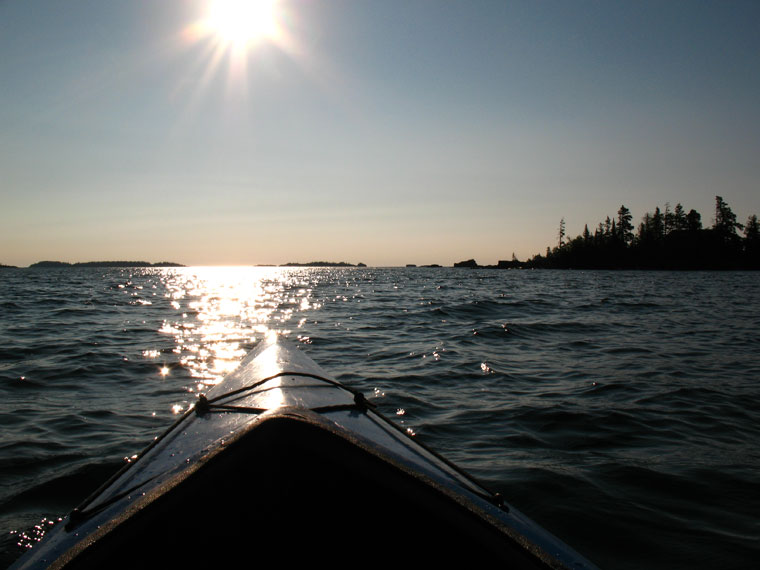
    A couple of hours later, I was floating in a kayak. I saw that they offered rentals, so decided to go on one final adventure before boarding the Isle Royale Queen IV once again.

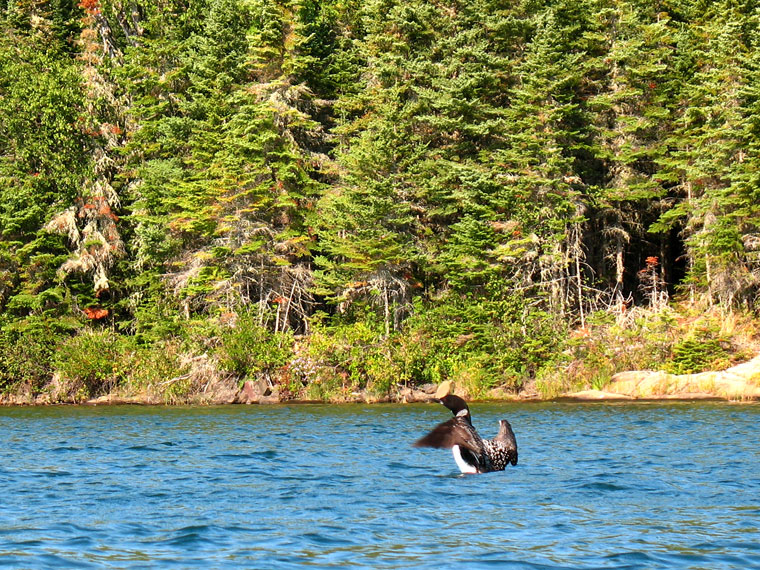
    I paddled around Tobin Harbor for four hours, hoping to catch another glimpse of a moose. I didn't see any but I did see two loons. I tried to close in on them to get a picture, but as I approached they dived underwater for a minute or so and pop back up in another location. They are like real life whack-a-moles. They made me look like a fool as I paddled back and forth helplessly.

    I passed several small islands, some inhabited by people vacationing in cabins. I paddled toward two ducks, that stood on a log floating in the lake, hoping to snap their picture, but before I could get close enough their fight or flight instinct kicked in and they flew away. Just once, I want a duck to choose fight. That should keep things interesting. If nothing else I’d find out what I’m truly made of.

    I took the kayak back to the beach and returned my paddle and life jacket. I still had over two hours before the boat arrived on the island, so I decided to go on a harbor walk with a small group lead by Ranger Marcia. I learned about useful plants that I wish knew about before my hike. Some edible, but most notable was a small feathery plant that is said to relieve the itch of mosquito bites if rubbed on your skin.

    When we returned from the informative walk, they were loading gear and kayaks onto the boat. A long row of passengers lined up along its side. I wasn't anywhere close to being ready to leave but I didn't really have a choice, right? I sat again in the stern of the ship and watched as Isle Royale faded away. A depressing sight.

    When we docked at Copper Harbor, I got back into my car and drove straight through for thirteen hours. I was surprisingly wide-awake for almost the entire time, until I was less than 40 miles from my house. Sleep deprivation finally started to set in.

    I started to hallucinate, or maybe I was actually asleep for a few seconds and dreaming. I thought I saw something run out in front of me. I swear it looked like an 18” tall Sasquatch, although I’m fairly certain it wasn't  With fifteen miles to go, I dreamed that the road dropped off on the left side until my lane looked like a plateau on a ridge overlooking a shear drop off.

    I couldn't take it anymore. This was not good. I stopped at a gas station and slept for an hour. I woke up suddenly, feeling like I had only slept for seconds then finished the last 15 minutes of driving.

    It didn't take long to find myself back into my routine, but Isle Royale will forever be a special place to me, a significant part of my timeline. I already want to plan a second trip, but I have too many other things on my list to do. It’s not a Yahtzee, you know. You don’t get bonus points for doing it more than once. Nevertheless, there is something unique about that place. It’s the most revisited national park in the country and now I know why.

    All that life is, is the present moment and a collection of memories from past moments. If I fill too much of my past with those repetitive, ignored memories, instead of living in the here-and-now then it’s no mystery why my time has flown by.

    I spent so much of my time off at home, thinking I couldn't afford to do the things I wanted to do. I was wrong. (This trip was just over $300, including gas.) I have no good excuse for staying home anymore. Life is too short and too important. These six days will never be forgotten, blocked out or ignored as insignificant. Every detail will be with me forever.

    Creative Commons License
    A Backpacker's Life List by Ryan Grayson is licensed under a Creative Commons Attribution-NonCommercial-NoDerivs 3.0 Unported License.   

    Tuesday, February 19, 2013

    Re-post of My Journal From Isle Royale, Part 5

    The Darkest Sky
    Click Here for Part One


    The morning was chilly, but I didn't need a jacket . I ate breakfast, read a book, and once again listened to the loons. I packed up camp slowly, paying attention to the quality of my actions. I cleaned every piece of gear unhurriedly before carefully packing it away. I accomplished another one of my intended goals. Life was moving at a snail’s pace.

    I decided to go back to Rock Harbor for my final night, where this hike began. Heading out of Lane Cove, back over balance beams and through clouds of bees.

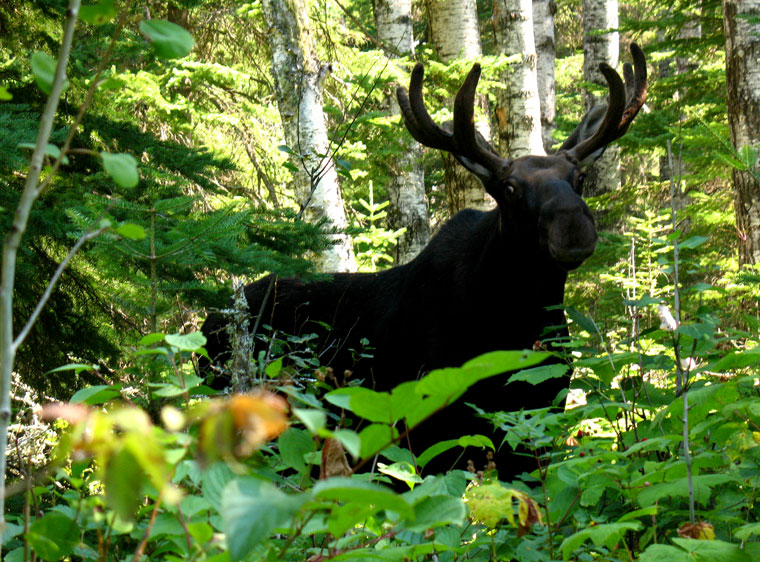
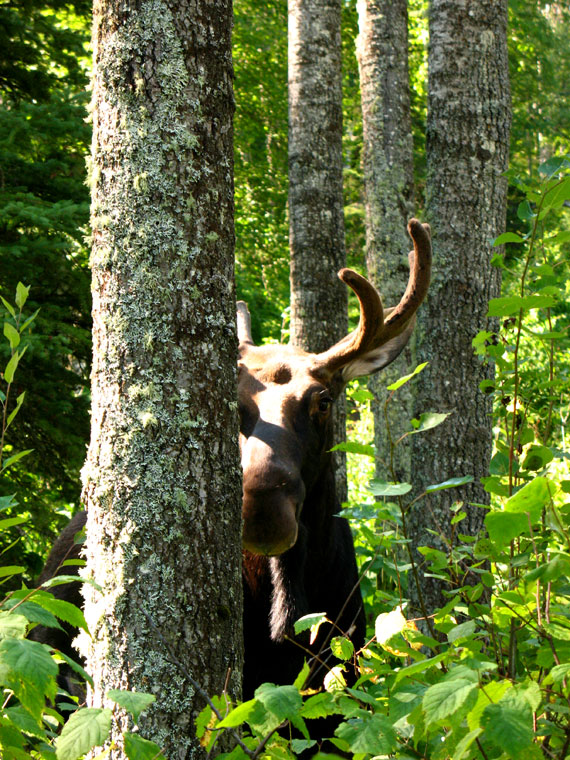
    I hiked along with my head down staring at the trail in front of me, then stopped suddenly. Just a few yards away, in the middle of the trail, stood two enormous moose, grazing and unperturbed by me. I don’t know what the safe distance was to be away from a moose, but it certainly wasn't this.

    I, of course, grabbed my camera and snapped a dozen pictures rather than retreat to a safer distance. When the first moose crossed the trail a few yards in front of me, I could see sores on its hind legs. They looked like bite wounds, fresh bite wounds. Did he escape from certain death nearby? Where wolves still close? I honestly didn't consider that much, though. I was too excited about the photos I was getting and mesmerized by their size and closeness.

    I moved towards the larger moose further up the trail. He wasn't facing me and didn't know I was there. I crept forward slowly, but still spooked him when he heard me behind him. He darted about 10 feet, but realized I wasn't a threat and went back to eating. The commotion, however, startled the first moose, which had now turned to face me. It seemed to move slightly forward, but this may have been my imagination. I thought his face looked concerned  or fearful. Fear can lead to anger, anger to violence. The kind of violence that makes you just want to headbutt an idiot with a camera. I backed away slowly, but continued taking photos like those tourists in Godzilla movies moments before their death.

    I learned later that moose can be more problematic than bears, and very aggressive during mating season, but that doesn't start until late September. This was early September, so clearly nothing to worry about. Once again, my naivety will one day be the death of me.

    With such a wonderful night, and being right in the middle of the moose’s world, I was on a naturalist’s high. I don’t even know what that means. I just know it doesn't get any better than this, at least not so far.

    Since I was in a hurry the day before, I walked back up Mt. Franklin to sit and enjoy the view without feeling rushed. Several people came to check out the view, take a photo, and left quickly. I remained. I knew once I headed back down it might be the last I’d get to see it. As a result, it was hard to leave.

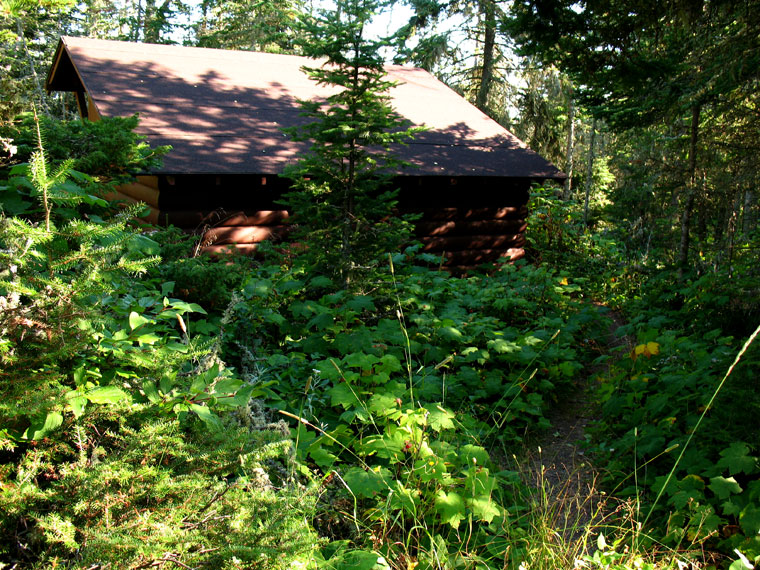
    At Rock Harbor campground, I expected to see it crowded and full of activity, especially since it was Labor Day weekend. Other than the side with the restaurant and lodge, it was the opposite. I pretty much had the pick of whichever site I wanted. I choose to stay in one of the shelters. An empty 10 x 15 foot space with one wall made entirely of screen that faced the forest and a picnic table out front.

    Writings and drawings covered the walls and ceiling inside. There were signatures, poems, short reports about experiences, testimonies, and commentary. One thing was clear, even those who wrote about bad experiences from weather or failed gear, enjoyed their stay and wanted to come back.

    I left my gear behind and went to check out the slightly more civilized part of the island. I felt out of place. I was a guy from the woods who has been drinking water from the lake and lying on the ground. They were drinking wine on a patio. It’s a very small section, but where a lot of people congregated. I thought about getting a meal at the restaurant, but turned down the $35 cost. Instead, I walked down a trail and discovered a deck with benches angled towards both the sunrise and sunset. A few other people came and went, but everyone left before the sun completely set. I stayed, happy to be alone.

    Daylight faded like a retractable roof revealing the cosmos. The smell of campfires started to waft over in the breeze. The first point of light to emerge was Jupiter, then Vega, the Big Dipper constellation, the Northern Cross, Cassiopeia, and a small handful of other stars light-years away. Soon, thousands of others joined them.

    The dark sky was full of stars, more than I have ever seen in a night sky, but I can still only see a fraction of all that exist with the naked eye. There are hundreds of billions in our galaxy alone, which is one of hundreds of billions of galaxies. There are more stars in our universe than grains of sand on all the beaches on earth. Nobody ever believes me when I say that, but it's true; ask any astronomer or statistician (if you can find one). I cannot help but wonder how many of those stars hold planets in their gravitational grasp. How many of those planets support life? What color are the plants where their entomological dramas unfold?

    Light emitted from these stars takes years to reach my eyes. In fact, the stream of light from each star left at different times, so every twinkle that I see represents a different moment in history. The light from Vega, which I can see now, left its source in about 1983. That’s before the Cosby Show and the creation of Alf. Think about it.

    The ancient light from Mu Cephei started its voyage towards earth while humans were entering the Bronze Age, fighting wars with copper and bronze weapons, constructing Stonehenge, and for the first time using plows, pottery wheels, and interestingly, astronomy itself. The starlight is on a journey so long that when it finally passes by, I am not using copper for weapons anymore, but in the circuitry making it possible for me to later Google this information about the 4th century B.C.E.

    The Andromeda galaxy is just a pale white point of light to the naked eye. That beam’s voyage is so old that pre-human hominids were tramping over the same planet, which I now lay, with the first primitive stone tools ever created. Now here it is colliding with my retinas and registering in my brain not as just another pale light from far away, but conjuring up feelings about my life of both insignificance and precious rarity. Whenever I am taking my life too seriously and need brought back down to earth, I simply have to look up.

    I wish I could hold onto these moments always. Permanently slow things down. A rushed life finally unhurried. Regrettably, I know it will not last forever; but thanks to a love of the natural world, I will forever know that at any time I can get it back. Even in the realm of the known, without making up fantastical and magical stories, the world can be seen as fascinating, miraculous, and enchanting; and should above all, never be seen as repetitive and boring.

    I had to put on my headlamp to see the trail for my hike back. When I neared the resort’s lights, I temporarily turned my headlamp off and strolled with my eyes still pointed at the sky. This caused me to veer off the trail and nearly trip, but I just couldn't keep my eyes off it. This was my last night; I had to take it all in and make it last. After all, it might be the last I’d get to see it.

       
    Creative Commons License
    A Backpacker's Life List by Ryan Grayson is licensed under a Creative Commons Attribution-NonCommercial-NoDerivs 3.0 Unported License.   
    Sunday, February 17, 2013

    Re-post of My Journal From Isle Royale, Part 4

    Greenstone Ridge Trail
    Click Here for Part One


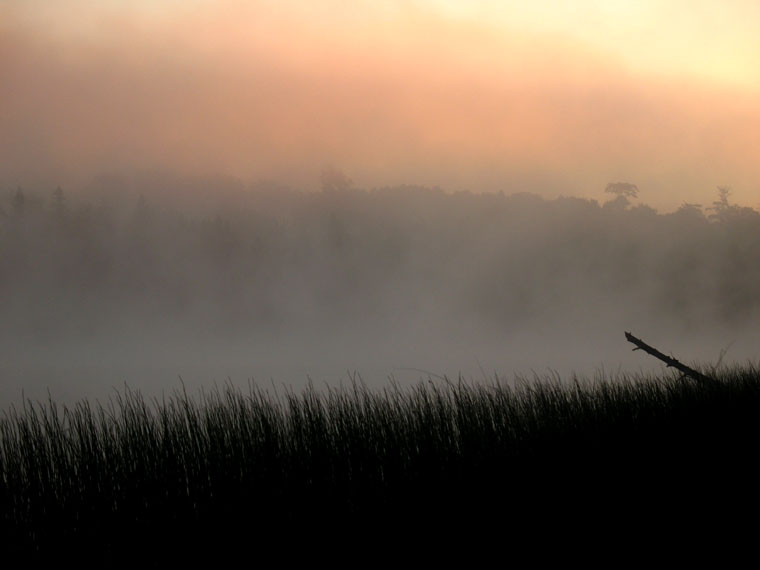
    At first light, my stealthy moose search began. I can't lie, I’m excited to be able to say that. I crossed over moose-made paths and puddles from moose-made footprints. It was a chilly 47°. A thick fog drifted across the lake under a peach sky. A river otter enjoyed a cold early morning swim.  I stood patiently by the lake with my camera, but there were no moose to be seen.

    I went back to camp and lounged in my hammock listening to the early birds. Their songs are a little different this far north. “Burlap, burlap.” “Tweep, tweep,” some birds said, with their crazy northerner accents. I moved back to my cozy tent and sleeping bag to warm up. Apparently too cozy, I slept for an additional four hours. The day started late. I didn't get on the trail until 1:30 and I had over thirteen miles to go. I intended to start at a decent time. So much for that.

    Pictures couldn't do it justice
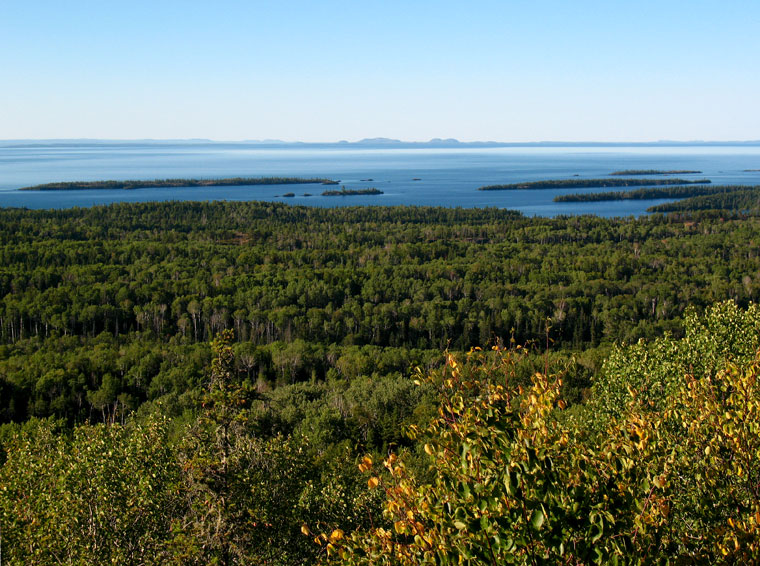
    My next target was Lane Cove via the Greenstone Ridge Trail. It was rougher than the previous trail, but there were some amazing views. As I got to the top of the first overlook, I was kind of awestruck. I was high enough to see the surrounding islands, which formed the archipelago.  My tense body slumped as I exhaled a “wow”. I had no idea there would be such views or that the ridge would be over 1,000 feet high. There is something to be said for under planning and letting yourself be surprised.

    I saw several small islands and a hazy Canadian shore. I joined a fellow hiker sitting on the edge of exposed bedrock. I sat down with my feet hanging over the side. He was on day 2 of 16. We talked for a few minutes. He wasn't carrying a lot of food but would instead go fishing each night to catch dinner. He gave me some information about the trip to Lane Cove and continued on his way. I stayed there for a while longer to take it all in. I knew I didn't have a lot of daylight left, but to hell with deadlines, I have a headlamp.

    This was not the only excellent lookout from Greenstone Ridge. Much of the ten miles I spent on it today were in view of the Lake a thousand feet below. I climbed the fire tower on Mount Ojibwa, to get as high as possible. I could see the Rock Harbor lighthouse over a mile away. I began to fall in love with the place. A couple of generations ago, a several motivated people fought relentlessly to turn this into a national park, to protect it from over-fishing  logging, the building of resorts, and other financial exploitation. I now sensed a connection with those people. I understood why they remained so diligent. I would have been proud to fight alongside them.

    After descending from the ridge, I was back in the thick trees. The forest was wetter the further I hiked down. Moss clung to rocks and logs. Sage green lichens draped Birch trees. Slippery bog bridges lifted me above the wetlands, which frogs and snakes claimed as their home. Unfortunately, so did the mosquitoes. They swarmed in clouds, so I started to get frustrated and ready to be finished for the day.

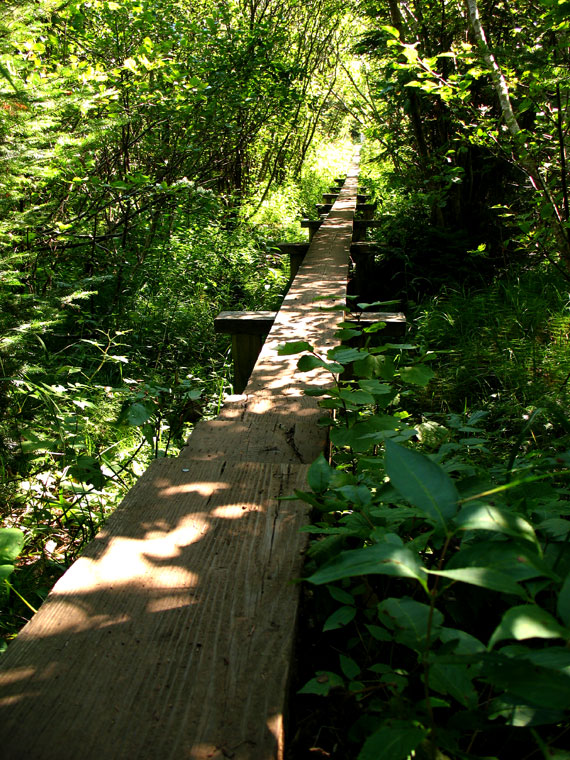
    A particularly long stretch of bog boards were about two feet off the ground and just over a foot wide. A heavy pack can pull you down if you lean to one side too much. That combined with a nervousness of falling and the constant swatting of mosquitoes, I felt like I was on one of those weird Japanese game show obstacle courses. I heard the announcer in my head as I walked across. “Alright and he’s off, over the balance beam, crossing the stagnant watery pit of snakes, uh oh he’s crouching down to take a picture of a pretty S-shaped snake laying in the water, a potentially devastating choice as this could compromise his stability, ooh and a massive hit on his right by the mosquito swarm. That frantic swatting is going to cost him his sense of balance, but wait a minute, he’s back up and he finishes in record time! Stay tuned for more Super Happy Joy Fun Show!”

    Anyway, so the mosquitoes were annoying. I began referring to them as skeeters, which is the derogatory slur to use when wanting to intentionally show them disrespect. I constantly smacked and swatted at them. I really don’t like killing anything. I don’t even kill insects in my house. Some I give sanctuary, others I carefully pick up and set outside in the safety of a bush.  Nonetheless, with mosquitoes, I got a definite sense of satisfaction when killing one. Sorry skeeters, but nobody likes you. 

    By the time I arrived at Lane Cove, the mosquitoes were mostly gone. The frustration instantly eroded and I was thrilled that I chose to hike the extra two and a half miles to get here. The site bordered the cove and the view pointed towards the opening into Lake Superior. The water was shallow for several feet so provided plenty of room for wading and rinsing off. I set my gear down, put on my water shoes, and headed into the lake.

    Superior is always cold and today wasn't an exception. The average yearly temperature is in the 40s or 50s. It seemed a bit warmer than that, but not by enough.

    I waded out until I was thigh deep and started to shiver, but it felt great. I hesitated due to the cold, but I wanted to be submerged. Before I could think about it too much, I held my breath and went under. It was exhilarating at first. I became acclimated just enough to tolerate it but never fully. I swam further out. My head popped above the surface while treading. I breathed air into my tightened lungs with short, almost hyperventilating breaths. Obviously, I’m not use to this.

    I went back under and moved to shallower water so I could stand. I took a few more breaths, went under again, and swam towards the shore until my hands and knees grazed large fist-sized rocks on the bottom. It felt incredible. A cold swim after a few days of backpacking under a layer of sweat and grim is one of life’s most invigorating moments. I rolled onto my back then to a sitting position for a few minutes before getting out and drying in the sun.

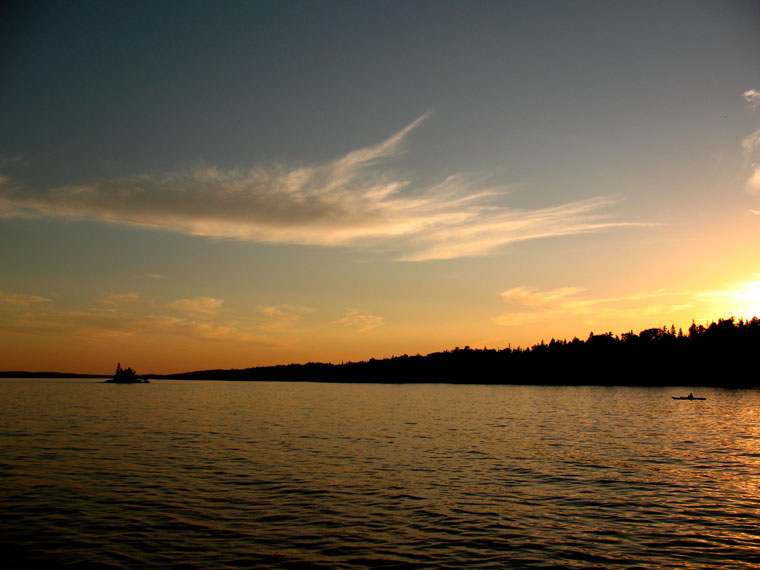
    There wasn't much daylight left, so I prepared camp. Periodically I’d stop to admire the sunset. After making myself at home, I lay on my back on a bench made of a large log planed down so it was flat. My head rested on my hands with fingers intertwined. I realize that the rush of the day is not for me. I wish I had gotten here earlier. My previous treks have been too hurried, this day included. That is not why I hike, not why nature draws me in. This was it, this simplicity, this kind of moment. Am I paying attention to it?

    When I look up at the sky, I'm reminded that in over four billion years it has never looked exactly the same way. The clouds arranged in this particular combination of shapes and colors, moving in this particular way, will only exist at this moment and never again. I wish I could always remember that when I need to slow things down, live in the present and see something new, I simply have to look up.

    I roll over onto my side, hand now propping up my head, occasionally scribbling in my journal. I concentrate on the feeling of tall grasses touching my skin, the smell of dirt, and start to see just how much is going on around me. Paying attention to the little things, which I normally block out, is another way to slow things down and live in the moment.

    Over green chlorophyll and soil, an insect lived out his days with a struggle, drama, and determination that I cannot even imagine. It’s common to see the plants, not as living things, but as lifeless as gravel or mud, even though we share DNA. If they moved at a faster time-lapse pace, turning their leaves quickly towards the sun and slithering their roots under my feet, how different would they seem? Would I give them personality? Would I talk to them and give them names? Would I think twice before picking a flower?

    The diversity and cooperation between plants on the island is also admirable. There are species that wouldn't ordinarily be able to survive on Isle Royale, due to its poor soil quality with low levels of nitrogen. Some species of plants, however, convert the nitrogen in the air and put some back into the soil in forms other plants can use to survive. Below me, even though I can’t see it, I know an overlooked world exists buried under tons of dirt, roots, bedrock, and water, churning away unknowing and selflessly keeping everything alive and growing here on the surface.

    Just as important is the microscopic life, which is so abundant that if everything we can observe with the naked eye were to disappear, we would still see ghostly outlines of it constructed out of trillions of bacteria and nematodes.

    The lichens covering the trees and rocks look like a single organism, but are actually comprised of fungus with algae or cyanobacteria, or both. The fungus provides structure and nitrogen allowing the algae or cyanobacteria to photosynthesize and provide food for the fungi. One would not survive in this beautiful form without the other. "Lichens are fungi that discovered agriculture," as one lichenologist put it. This delicate cooperation illustrates both the strength and endurance of the island but also the fragility and teamwork required to maintain it.

    So much of this activity is going on continuously, and yet, I typically fail to pay attention to it. It's a magnificent world and largely ignored in the course of the average day. A nearly useless and unclaimed dollar bill blows across a parking lot and most of us will go out of our way to chase it down. At the same time fail to see the priceless things always around us, each one blocked out as repetitive and insignificant.

    The sun was now set, the clear sky still a bright, but now darkening blue. The absence of moon and city light made every possible star visible. Periodic breezes hissed through the pines and water gurgled against the rocks on the shore. This is the time of my life.

    SMACK, the sound of another dying mosquito. “Thought you were going to bite me, huh? Skeeta please.”

    I moved to my tent to be away from them, so they wouldn't take away from this moment. I sat up late reading and writing. Occasionally I’d lie on my back to gaze up at the unusual amount of stars that I normally can’t see at home. Along with many other things, complete darkness is something I forgot how to appreciate.


    Creative Commons License
    A Backpacker's Life List by Ryan Grayson is licensed under a Creative Commons Attribution-NonCommercial-NoDerivs 3.0 Unported License.